Download the Burbank seller checklist
A printable checklist covering valuation, documents to gather, preparation, California disclosures, and the escrow process.
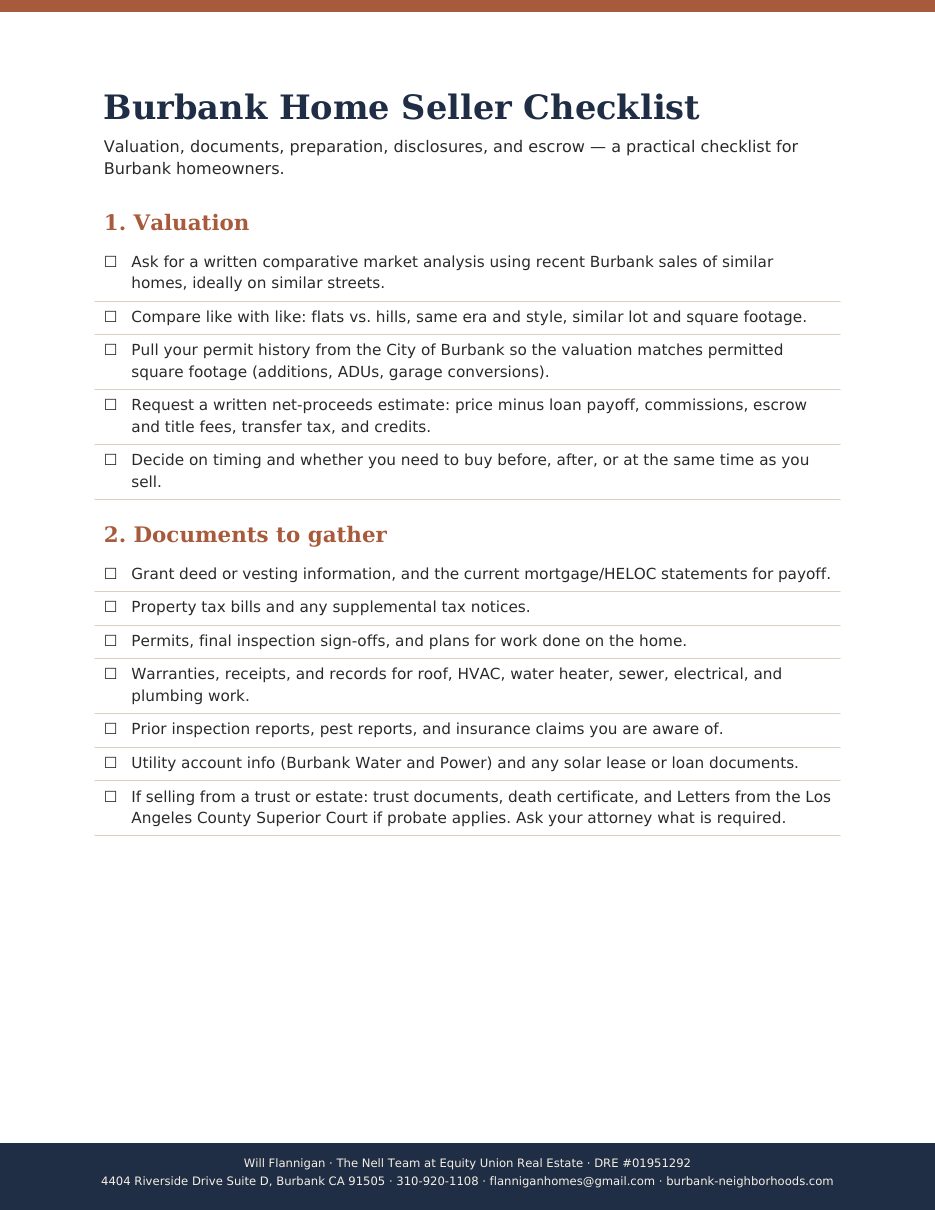
Can't see the preview? Open the checklist in a new tab.
Download the checklist (PDF)Selling well in Burbank is a sequence, not a season: a valuation built on the right comparables, a permit record that matches the house, preparation that fixes what holds a sale together, and a launch that uses the first three weeks instead of spending them. This page is how that works, in plain language.
I'm Will Flannigan, a Burbank real estate agent (DRE #01951292) with The Nell Team at Equity Union Real Estate. I've lived in Burbank for about twenty years and I list and sell homes in every Burbank neighborhood — from Magnolia Park bungalows and downtown condominiums to Burbank Hills view homes — with trust and probate sales and Mandarin-language service as specialties.
Pricing is a comparison, not a formula. The right comparables match your street, your lot, your view and your condition. Overpricing at the start costs you the first three weeks, which are the weeks with the most attention — so the number comes from evidence, and you see the evidence.
Unpermitted work is the most common problem in Burbank transactions and the one that most often stops a buyer's loan. Before listing, the public record gets compared with the house — every addition, converted garage, bathroom and ADU — so a buyer's lender finds nothing you didn't already know about.
Most sellers over-invest in cosmetics and under-invest in the things that actually hold a sale together: a sewer camera report on an older home, a panel that isn't original, and a clean, uncluttered floor plan. De-cluttering and good photography move more buyers than a renovation that isn't finished in time.
The first three weeks carry the most attention a listing will ever get, so the home goes to market finished, photographed and priced — not tested. The plan is set before the sign goes up, not adjusted after the showings go quiet.
Most Burbank transactions close in thirty to forty-five days, with cash deals faster and anything involving a trust, an estate or a court confirmation taking longer. You get the net-proceeds figure in writing before you sign a listing agreement, not at closing.
The same city, four very different sales. The plan changes with the property and the people — the standard doesn't.
A house held for decades usually has original systems, unpermitted work from another era and a family with opinions. The valuation accounts for condition honestly, and the preparation plan separates what buyers pay for from what they don't.
Trustees and executors have duties to the beneficiaries, not just a house to sell. All Burbank probate cases go through the Los Angeles County Superior Court, and court-confirmation sales have their own calendar. This is a specialty, handled in English or Mandarin Chinese.
A view home above Glenoaks Boulevard is priced off view, access and lot — and buyers will ask about the fire zone and insurance early. Having those answers ready before listing keeps the escrow together.
Downtown and Media District units sell on the building as much as the floor plan: dues, what they include, parking and the association's finances. The comparables come from the same complex or the ones genuinely like it.
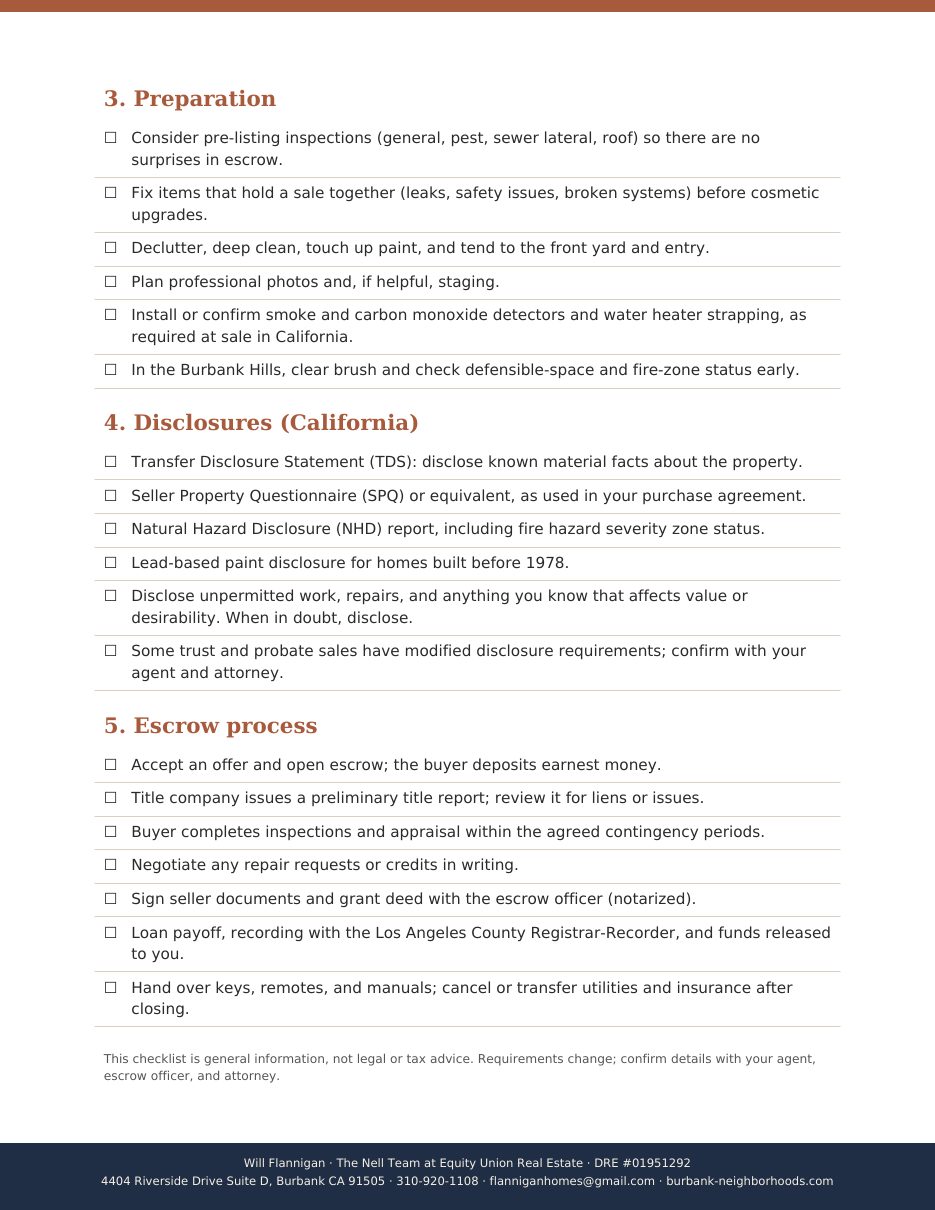
A printable checklist covering valuation, documents to gather, preparation, California disclosures, and the escrow process.
Can't see the preview? Open the checklist in a new tab.
Download the checklist (PDF)Start with three things in this order: a written valuation based on sales that actually match your street, lot and condition; a permit check so the public record matches the house; and a preparation plan that fixes what holds a sale together rather than what merely photographs well. From there, pricing, photography and the first three weeks on the market do the heavy lifting.
It depends on evidence, not a formula. The right comparables match your street, your lot, your view and your condition — a downtown condominium, a rebuilt Magnolia Park bungalow and a hillside home with a view are priced off different sales even when they share a bedroom count. Ask for a written valuation of your specific address rather than an online estimate.
Fix what holds a sale together before what decorates it: permit records that match the house, a sewer camera report on an older home, an electrical panel that isn't original, and a clean, uncluttered floor plan. De-cluttering and good photography move more buyers than a renovation that isn't finished in time.
Spring is the busiest market in Burbank and late summer the slowest, but a well-priced, well-presented home sells in any month, and waiting for a perfect season usually means listing into a crowd. If your situation has a deadline — a trust, a relocation, an estate — the calendar matters less than the preparation.
Your net is the sale price less the commission and any agreed concessions, the seller's closing costs, escrow and title charges, transfer taxes and any repairs you agree to. Ask for that figure in writing before you sign a listing agreement rather than discovering it at closing.
Yes. Trust and probate sales are a specialty, and all Burbank probate cases go through the Los Angeles County Superior Court. These sales have their own timelines, notice requirements and sometimes court confirmation, so they take longer than a standard sale — the preparation plan is built around that from the start.
How the neighborhoods differ, the schools, the utilities, and the checks every buyer should run.
Read more →What homes are worth, how long they're taking to sell, and how the market has moved.
Read more →Selling a home held in a trust or an estate, through the Los Angeles County Superior Court.
Read more →Or head back to the Burbank Neighborhoods homepage.
Thinking about selling? Tell me the address and I'll tell you what it's worth, what to fix and what to leave alone, and what you'd actually keep — in writing, before you sign anything. English or 普通话.